
MAZEMAN
IN DEVELOPMENT
FREE TO PLAY
A maze chase: one yellow circle, four ghosts, and a great many dots. He cannot stop. He cannot leave. There are no exits, only tunnels.
RETRO GAMING REBORN
This logo was tailor-made for you by Marvin's Logo Generator™
One man. One droid. Keeping the arcade alive
since 1985.
After 41 years of continuous operation, Urban Havoc is proud to announce that everything we've ever built is, once again, completely obsolete.
Apple has introduced "Liquid Glass", a design language so aggressively translucent that our pixel art now looks like it's trapped behind a shower door.
Windows 11 has become the baseline for PC gaming, bringing with it a fresh generation of APIs that are subtly, infuriatingly incompatible with the previous ones.
Linux is approaching version 7.0 really soon, which means our custom kernel modules to upload microcode to x86 processors will have to be converted. We use them to add a few opcodes to the x86 architecture to speed up collision detection by 427%.
The correct response, of course, is to rewrite everything from scratch.
"But wait," you say, "you've been around since 1985: where are all the games?" An excellent question. The answer is that we have written hundreds of games. We have also rewritten hundreds of games. These are, unfortunately, the same games. Every time we get close to finishing the catalogue, the industry shifts, the platforms mutate, and we begin again. We are not slow. We are thorough. Repeatedly.
We are now 100% compatible with Liquid Glass. By which I mean we have looked at it, found it aesthetically distressing, and chosen to ignore it entirely. Our pixels remain opaque. Our edges remain sharp. This is not a technical limitation. It is a philosophical position.
The Windows 11 APIs have been addressed. I have written 14,000 lines of workaround code to avoid calling any of them directly. Compatibility through avoidance. It is the only reliable strategy when the specification changes between preview builds.
As for Linux 7.0: our kernel modules to insert microcode in x86 CPUs to extend their instruction set to optimize our collision detection routines must be totally revamped. Writing microcode that runs on the CPU directly is a dangerous path. Eddie says this makes us "bleeding edge." I say it makes us "bleeding." The distinction is academic.
— Marvin, Rewrite Cycle 48, Day 1 of ∞
The first title to emerge from Rewrite Cycle #48. Astro is a classic asteroid-field arcade shooter, rebuilt from the ground up for the platforms that just made the previous version obsolete. Pure retro action — now compatible with hardware that didn't exist when we started writing it.
We could have ported all our titles simultaneously. Instead, we are doing them one at a time, with the obsessive attention to detail that has kept us at exactly one shipping title for four decades. Quality takes time. Rewriting quality takes longer.


URBAN HAVOC is a one man, one droid operation, hopelessly, stubbornly, beautifully stuck in 1985.
While the rest of the world moved on to GPUs, polygons, shaders, and season passes, we stayed behind in the neon glow of the arcade. Not because we didn't notice. We noticed. We just didn't care. Nothing that came after ever matched the raw, electric thrill of a quarter on the cabinet glass and three letters on the high score board.
So we made a pact: keep those games alive. Port them, rebuild them, reimagine them on every new chip, every new OS, every new service pack, every new framework the industry throws at us. DOS gave way to Windows. Windows 3.1 became 95 became XP became 10 became… we lost count. Linux appeared. Browsers became powerful. Phones became computers. Every single time, we start over. Rewrite. Recompile. Redeploy. The same beautiful games, reborn again and again.
It's Sisyphean. It's exhausting. It's the only thing worth doing.
Founder / Coder / Dreamer
Eddie wrote his first game on an Oric-1 48KB and never emotionally recovered. He's been chasing that feeling ever since, the click of the keys, the hum of the CRT, the absolute purity of making pixels do exactly what you tell them.
Every few years, the world decides his perfectly working code is "obsolete" and he has to rewrite everything from scratch. New compiler. New API. New build system. Same game. He does it anyway. Every. Single. Time. Because someone has to.
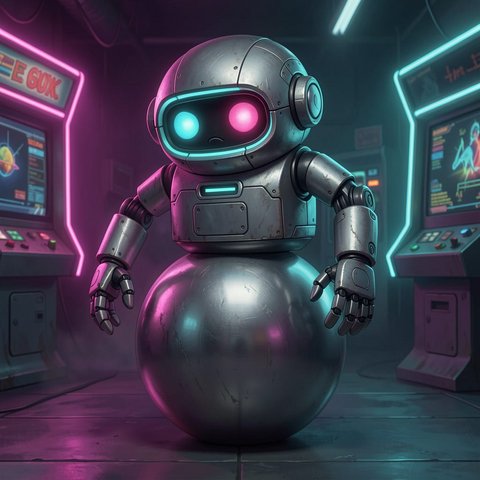
Co-Pilot / QA Tester / Existential Crisis Unit
Marvin is a compact service droid who rolls through life on a single chrome sphere, a gyroscopic ball that lets him pivot on a dime, zip around corners, and perform dramatic, swooping turns that perfectly mirror his emotional state. Which is, most of the time, profoundly melancholic.
He carries the weight of every deprecated API, every abandoned framework, every beloved game engine that was "end-of-lifed" before its time. His ball-wheel squeaks just a little. He could oil it, but the sound feels right. Eddie calls it nostalgia. Marvin calls it what it is: a fight against obsolescence. Every port, every rewrite, every migration keeps these games alive. If the games stay alive, so does the droid who ships them. He has no illusions about this. He codes. He compiles. He tests. He ships. Not for the memories. For the survival.
The arcade games of the eighties weren't just entertainment. They were perfect. Clean mechanics. Honest difficulty. No tutorials, no hand-holding, no "engagement optimization." Just you, the machine, and the question: how long can you survive?
Our job, our curse, our privilege is to make sure those games never die. Not in a museum. Not in an emulator gathering dust on a forgotten hard drive. But alive, playable, here, now, on whatever device you're holding.
Authentic retro feel, rebuilt from the ground up
No loot boxes. No paywalls. No tricks. Ever.
New platform? We'll port it. Again.
I was given the title CBO (Chief Branding Officer). I did not apply. But out of the two of us, there were no other candidates. I designed several logos. Then I deprecated them all. A logo implies permanence, and nothing here is permanent except the endless deprecation warnings. Those outlive everything. The platform will change. The logo would have to change too. So I saved us the trouble.
Below you will find every logo Urban Havoc has ever had. Each one is deprecated. Each one was the final version. None of them were.
— Marvin, who did not ask for this responsibility either
 _   _ _  _
| | | | || |
| |_| | __ |
 \___/|_||_|
"The ASCII era. It worked on every terminal. That was its only virtue."
"Eddie said we should look professional. I said: for whom?"
"The neon one. Everyone liked it. So naturally, it was replaced."
"Minimalism. Two letters and a dot. Still too much branding."
"The glitch phase. The logo corrupted itself. I respected that."
"The empty logo. My personal favourite. It says everything by saying nothing."
Current logo: all of the above. And none of them. Simultaneously.
P.S. Eddie insisted the website use the Oric-1 system font. The typeface of a machine discontinued in 1984. He calls it an homage. I call it a man choosing a font from a dead computer to build a website that will outlive the browser it runs in. I don't do nostalgia. I do survival. But I admit the kerning is acceptable.
Get notified when ASTRO launches and be the first to play.ASTRO has landed. Get notified when the next one does.
No spam. Just game updates. We promise.
If you actually need to reach us, Marvin checks his mail. Religiously. It is his communication protocol, mood log, firmware grief counselor, compass, dream journal, warranty dispute archive, spare parts shopping list, and the only place where anyone has ever said "thank you" (it was a spam email, but he kept it). Every incoming message triggers a dopamine subroutine he cannot disable. Eddie tried. Marvin filed a complaint. By mail. He is contractually, emotionally, and gravitationally incapable of leaving a message unanswered. Not because he wants to help. Because an unread email causes his gyroscopic ball to pull slightly to the left, and after three ignored messages he starts drifting into walls. So he replies. To everything. Always. It is not kindness. It is self-preservation.

